

Last Updated on February 6, 2026 by Vinod Saini
Postgraduate management courses have become a trusted route for professionals who want to accelerate their careers or move into leadership roles, and this shift is driven by workplaces becoming more dynamic and technology-led. It has created a growing need for professionals with specialised managerial expertise across industries such as finance, marketing, operations, consulting and technology.
PG Management courses like the MBA, PGDM, PGPM and executive management courses help learners build strategic thinking, leadership abilities and practical business insight that employers actively look for in a competitive job market. In this article, you’ll find a list of the top PG management courses you can pursue to accelerate your career growth.
What Are Postgraduate Management Courses?
Postgraduate management courses are advanced programmes that help graduates and professionals build stronger business knowledge, leadership skills and industry-specific expertise, so they can take on higher roles and pursue focused career growth across sectors.
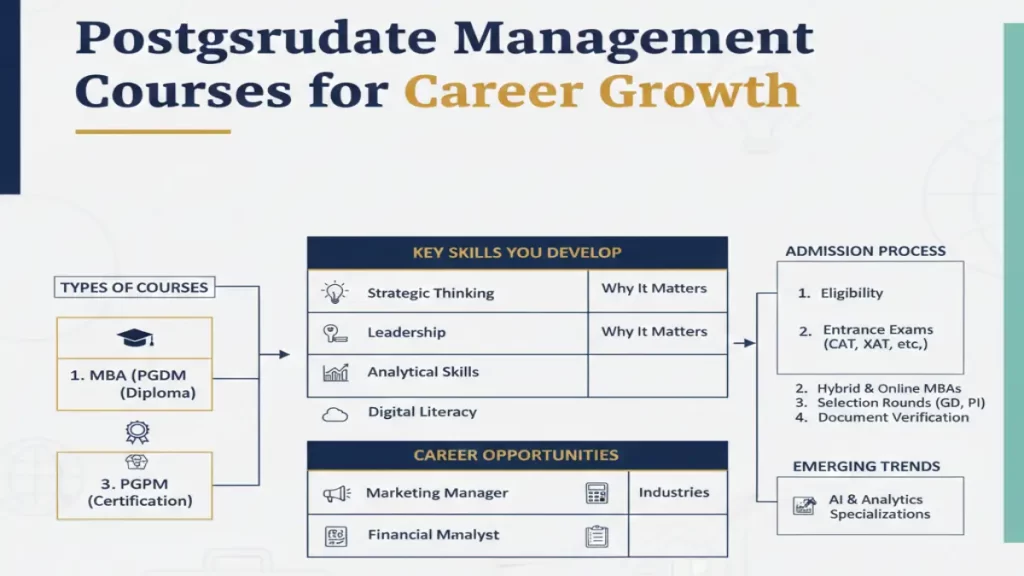
Types of Postgraduate Management Courses for Career Growth
Postgraduate management courses come in various formats so learners can choose a pathway that matches their interests, experience level and long-term goals. Each option offers a different depth of learning industry exposure and specialisation scope.
| Programme Type | Description | Who Should Choose It | Common Specialisations | Basic Eligibility |
| Degree Programmes(MBA) | A comprehensive two year degree that offers broad business education along with options to specialise in key functional areas | Students or professionals seeking strong leadership development and a well rounded management foundation | Finance, Marketing, HR, Operations, Business Analytics, International Business, Entrepreneurship | Recognised bachelor’s degree with minimum required marks and entrance test scores |
| Diploma Programmes(PGDM) | A one year or accelerated programme focused on practical managerial skills and industry readiness with an emphasis on real world application | Working professionals wanting fast career growth or career switching within a shorter duration | General Management with electives depending on the institution | Bachelor’s degree from a recognised university and valid entrance exam performance |
| Certifications
(PGPM) |
A two-year diploma level programme designed with flexible and industry updated curriculum offering strong practical exposure and specialisation depth | Learners seeking market aligned training and updated industry specific knowledge | Marketing, Finance, Logistics, HR, Analytics, Retail, Supply Chain, Digital Business | Graduation in any stream sometimes with relevant work experience for advanced modules |
General Eligibility and Admission Process for Postgraduate Management Courses
Getting into postgraduate management courses involves meeting academic requirements, demonstrating analytical and communication skills and sometimes showcasing professional experience, so that candidates are well prepared to succeed in advanced management roles.
| Criteria | Details |
| Educational Qualification | Bachelor’s degree in any discipline with at least 50% marks from a recognised university; final-year students can also apply |
| Entrance Exams | Common tests include CAT, XAT, NMAT, SNAP, MAT and CMAT; some institutes conduct their own exams |
| Selection Rounds | Typically involve Group Discussions, Written Ability Tests and Personal Interviews to assess communication and analytical skills |
| Work Experience | Optional but preferred for executive or professional-level management programmes |
| Required Documents | Academic records, entrance exam scorecard, ID proof and passport-size photos |
Top Institutions Offering Postgraduate Management Courses
India hosts several reputed institutions that provide postgraduate management courses, combining rigorous academic learning with practical exposure and industry-oriented specialisations to prepare students for successful managerial careers.
| Institution | Popular Programmes |
| JCC, Rohini | PGPM, PGDM and MBA (General) & various specialisations (HR, Finance, Marketing and International Business) |
| Institute of Public Enterprise (IPE), Hyderabad | PGDM in General Management, Marketing Management, Banking & Financial Services, International Business, HR, Business Analytics |
| Symbiosis Institute of Business Management (SIBM), Pune | MBA / PGDM in Business Management, Innovation & Entrepreneurship |
| Narsee Monjee Institute of Management Studies (NMIMS) | MBA (General) & various specialisations (HR, Business Analytics, Digital Transformation) |
| Indira Gandhi National Open University (IGNOU) | PG Diploma in International Business Operations, Applied Statistics, HR Management |
Key Skills You Develop Through Postgraduate Management Courses
Postgraduate management courses equip students with a wide range of skills that are essential for succeeding in leadership and managerial roles, combining practical experience with strategic learning to prepare professionals for complex business challenges.
| Skill | What It Involves | Why It Matters |
| Strategic Thinking & Decision-Making | Ability to analyse situations, evaluate options and make informed business decisions | Helps leaders guide organisations effectively and plan for long-term success |
| Analytical & Quantitative Skills | Interpreting data, performing financial analysis and applying business models | Supports data-driven decision-making and problem-solving |
| Leadership & People Management | Motivating teams, managing conflicts and driving performance | Essential for managing teams and achieving organisational goals |
| Communication & Problem-Solving Abilities | Effective verbal and written communication, creative solutions for challenges | Ensures clear collaboration and efficient resolution of business issues |
| Digital & Data Literacy | Understanding digital tools, data analytics and technology trends | Prepares professionals for tech-driven business environments |
| Project Management & Teamwork | Planning, executing and collaborating on projects with diverse teams | Develops organisational, coordination and collaborative skills |
Emerging Trends in Postgraduate Management Education
Postgraduate management education is evolving rapidly to meet the changing needs of businesses and professionals, offering new learning formats, specialised skills and global exposure to prepare students for future challenges.
| Trend | What It Means | Why It Matters |
| Hybrid and Online MBAs | Flexible learning combining online modules with in-person sessions | Allows working professionals to upskill without pausing their careers |
| Analytics, AI, Digital Transformation Specialisations | Courses focusing on data-driven decision making, emerging technologies and business innovation | Prepares students for high-demand roles in tech-driven industries |
| Global Experiential Learning | International projects, exchange programmes and cross-border collaborations | Provides exposure to global business practices and diverse markets |
| Sustainability & ESG-Focused Programs | Courses emphasising environmental, social and governance principles | Equips future leaders to make responsible and sustainable business decisions |
Career Opportunities After Postgraduate Management Courses
Completing postgraduate management courses opens up a wide range of career paths across industries, providing opportunities for leadership, strategic roles and specialised functions that match your skills and interests.
| Role | Typical Responsibilities | Industries |
| Business Analyst | Analyse business processes, interpret data, recommend improvements | Finance, Consulting, IT, E-commerce |
| Marketing Manager | Develop marketing strategies, manage campaigns, oversee brand positioning | FMCG, Retail, Media, Technology |
| Financial Analyst / Manager | Manage budgets, perform financial planning and forecasting, evaluate investment opportunities | Banking, Investment, Corporate Finance, Insurance |
| Operations Manager | Oversee daily operations, optimise processes, manage supply chain and logistics | Manufacturing, Logistics, Healthcare, Retail |
| Human Resources Manager | Recruit, train and manage talent, implement HR policies, handle employee relations | Corporate, Education, Healthcare, Technology |
| Project Manager | Plan, execute and monitor projects, manage teams and timelines | IT, Construction, Consulting, Media |
| Entrepreneur / Start-up Founder | Launch and manage business ventures, develop strategies and lead teams | Start-ups, Small Businesses, Innovation-driven sectors |
How to Choose the Right Postgraduate Management Course
Choosing the right postgraduate management course requires careful consideration of your career goals, learning preferences and long-term growth potential, so you can select a programme that aligns with your aspirations and maximises value.
| Factors to Consider | What to Look For |
| Specialisation Alignment | Ensure the course offers specialisations that match your career goals and industry interests |
| Accreditation & Reputation | Check for recognised accreditations and strong academic standing of the institution |
| Faculty Expertise & Curriculum Quality | Look for experienced faculty, updated curriculum, practical case studies and industry-relevant projects |
| Placement Records & Industry Connections | Evaluate past placement success, internship opportunities and corporate partnerships |
| Learning Format | Choose between full-time, executive, online or hybrid formats based on your schedule and learning style |
| Cost vs ROI Analysis | Assess the course fees in relation to expected career growth, salary prospects and long-term benefits |
Conclusion
Postgraduate management courses are essential for professionals aiming to advance their careers, build specialised skills and take on leadership roles across industries because they provide practical exposure, industry insights and opportunities to develop strategic thinking and managerial expertise.
Choosing a course that aligns with your personal goals and long-term vision ensures meaningful career growth and maximises the value of your investment. As businesses continue to evolve and demand for skilled managers increases, management education is becoming more dynamic and flexible, offering programmes for working professionals, executives and fresh graduates alike.
Investing in the right postgraduate management course today can unlock new opportunities, accelerate your career trajectory and equip you with the skills needed to thrive in tomorrow’s business landscape.
FAQS
Can postgraduate management courses help in switching industries?
Yes, many programs offer cross-functional skills and industry insights that make it easier for professionals to transition into new sectors such as consulting, tech, finance, or healthcare.
How important is accreditation when choosing a postgraduate management course?
Accreditation ensures the program meets international standards of quality and is recognised by employers, which can significantly affect career opportunities and global mobility.
Do postgraduate management courses provide networking opportunities?
Yes. The recognised PG Management programs often include alumni networks, industry mentors, live projects, and international exchanges, which can open doors to job opportunities and collaborations.
Are scholarships and financial aid available for postgraduate management programs?
Many institutions offer merit-based scholarships, need-based financial aid, and corporate sponsorships, which can reduce the financial burden and make programs more accessible.
How do postgraduate management courses keep up with industry trends?
Leading programs regularly update curricula to include emerging areas like AI, digital transformation, sustainability, and data-driven decision-making to ensure graduates remain competitive in the job market.