Last Updated on April 5, 2026 by Vinod Saini
Taekwondo ethics aren’t a footnote to the physical training — they are the entire reason the martial art exists in the form it does today.
When General Choi Hong Hi codified Taekwondo in the 1950s, he built the five tenets — Courtesy, Integrity, Perseverance, Self-Control, and Indomitable Spirit — directly into the foundation of the art. These weren’t motivational additions. They were the structure. Every kick, every form, every bout in the Dojang is meant to be practiced through the lens of those principles. Without them, Taekwondo becomes athletic sparring. With them, it becomes something that changes how practitioners live outside the training hall.
Albert Camus put it plainly: “A man without ethics is a wild beast loosed upon this world.” In a martial art that gives students the physical ability to cause serious harm, the ethical framework isn’t optional — it’s the safeguard that makes training safe and purposeful for everyone in the room.
The Five Core Principles of Taekwondo Ethics
These five tenets appear on the wall of virtually every legitimate Dojang in the world. Most students can recite them. Fewer can explain what living them actually looks like — inside and outside training.
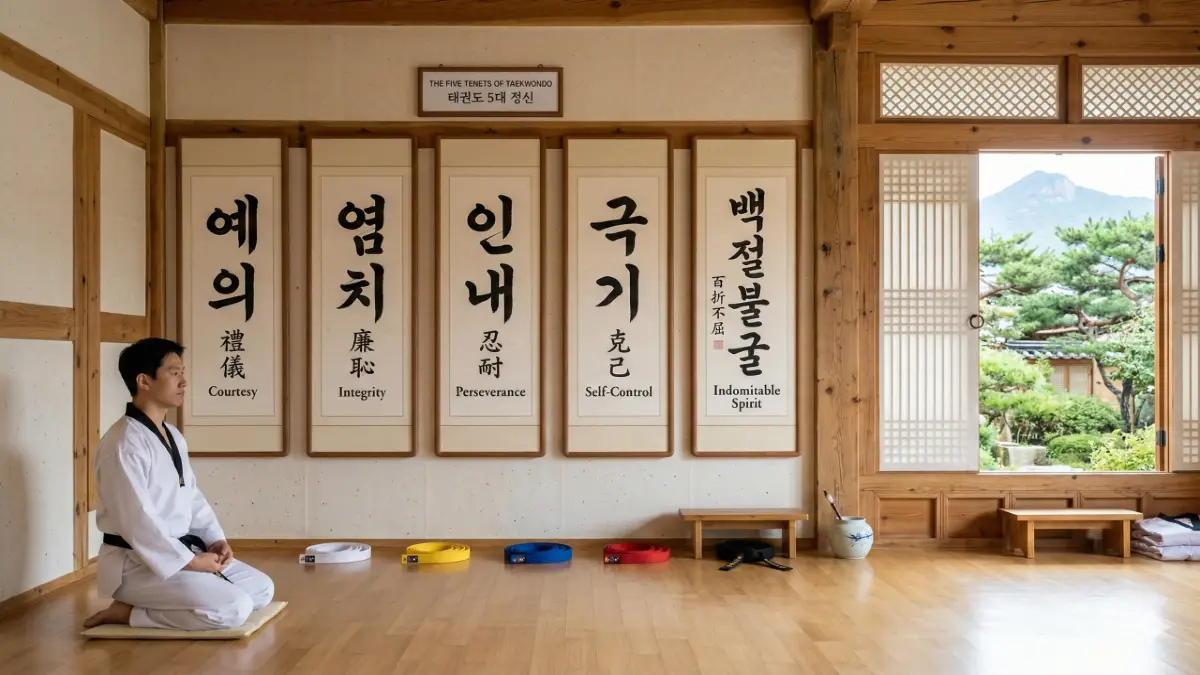
The five tenets represent more than classroom rules. They are a complete ethical operating system that shapes how practitioners think, respond, and carry themselves long after they’ve left the training mat.
Courtesy — Respect That Goes Both Ways
Courtesy in Taekwondo starts with the bow — to the instructor, to training partners, to the Dojang itself — and extends to how students carry themselves in every interaction. It’s not about formality for its own sake. It’s about building the consistent habit of acknowledging others before yourself.
In practical terms, courtesy means arriving on time, listening without interrupting, and treating the newest white belt with the same respect you’d give a black belt. Instructors who model this consistently produce students who genuinely internalize it, rather than just performing it during class.
Integrity — Doing the Right Thing When Nobody Watches
Integrity in Taekwondo means being honest about your technique, your effort, and your limitations. It means telling your instructor when you’re not ready to test for the next belt, rather than attempting to progress before you’ve genuinely earned it.
It also means not using your training to intimidate or cause harm outside the Dojang. A student who leaves class and starts unprovoked confrontations has violated integrity at its most basic level — taking physical skill and stripping it of its entire ethical purpose.
Perseverance — Staying When It Gets Hard
Anyone who has trained seriously in Taekwondo knows the moments when progress stalls, the same technique keeps failing, and walking away feels easier than staying. Perseverance is the tenet that keeps students in the room during those periods.
Research consistently shows that young martial artists who train through difficulty — rather than switching activities when progress slows — develop measurably stronger frustration tolerance, goal-setting ability, and academic persistence. The mat teaches a lesson that transfers directly into every other area of life.
Self-Control — The Tenet That Makes Everything Else Safe
Self-control is what separates trained martial artists from people who simply know how to fight. In sparring, it means controlling power, protecting your partner, and stopping when the referee calls time — even when adrenaline is running high.
(Taekwondo is practiced for self-defense and personal growth — never for unprovoked aggression. The ability to cause harm is precisely why the ethical commitment not to misuse it is so central to the art.)
Outside the Dojang, self-control means not reacting to provocation the way your training technically allows you to. Parents who enroll children specifically to help them manage anger, impulsivity, or frustration see the strongest outcomes when instructors teach self-control as a skill to develop — not just a rule to follow.
Indomitable Spirit — The Deepest Principle
Indomitable spirit is the hardest tenet to define and the most important one to develop. It’s the refusal to give up when the situation looks hopeless — not recklessness, but genuine inner resolve built through thousands of small decisions not to quit.
Practitioners who develop indomitable spirit through years of training describe it as the quality that shows up in the hardest moments of life outside martial arts: medical diagnoses, professional failures, personal losses. The Dojang builds this quality incrementally, in small moments of not stopping, until it becomes a genuine character trait rather than a temporary mindset.
Dojang Etiquette — Why the Rules of the Training Hall Matter
The Dojang isn’t just a room with mats. In traditional Taekwondo culture, it’s the space where the ethical and physical dimensions of the art are practiced simultaneously. The etiquette that governs behavior there reflects the five tenets in physical form.
-
Bow when entering and leaving — acknowledges the space and the tradition it represents
-
Arrive on time — punctuality is a practical expression of courtesy for everyone else’s training time
-
Keep the Dobok clean and maintain personal hygiene — reflects the self-respect the art is meant to build
-
Remove jewelry and sharp accessories — protects training partners before protecting yourself
-
Avoid unnecessary talking during instruction — demonstrates courtesy and focus at the same time
-
Address instructors by their appropriate title — Sabeomnim (사범님) in Korean tradition, or Sir/Ma’am in most Western Dojangs
Each rule maps directly onto one or more of the five tenets. Teaching students why the etiquette exists — rather than just requiring compliance — is what makes it stick as a genuine value rather than a behavior that disappears outside the training hall.
What Taekwondo Training Actually Develops in Students
Understanding Taekwondo ethics means understanding what a well-run training programme builds over time. Beginners often arrive expecting to learn kicks and self-defense moves. What they actually develop across months and years is considerably more layered than that.
Physical development is the most visible: flexibility, explosive leg strength, cardiovascular conditioning, and coordination all improve measurably with consistent training. Studies on youth martial arts practitioners show significant improvements in balance, motor control, and reaction time compared to age-matched non-practitioners.
Mental and emotional development is where Taekwondo’s ethical dimension shows up most clearly in measurable outcomes. Children who train for more than 12 months consistently demonstrate improved attention span, reduced anxiety scores, and stronger peer relationships — outcomes that directly parallel the five tenets operating in daily practice.
Self-defense capability develops alongside ethical judgment about when and whether to use it. Responsible instruction teaches students that physical ability carries an obligation not to misuse it — a lesson that distinguishes genuine martial arts training from combat sports focused purely on winning.
This is why physical fitness in Taekwondo is always understood as a vehicle for something larger, not an end in itself.
How Taekwondo Ethics Apply Outside the Dojang
The gap between students who genuinely transform through Taekwondo and those who simply get better at kicking usually comes down to one question: are the five tenets being practiced outside the Dojang as actively as inside it?
Instructors who take ethics seriously assign reflection exercises — asking students to identify a moment during the week where they practiced self-control, or where they failed to show courtesy and what they’d do differently next time. This approach, used in Taekwondo training programmes that emphasize character development alongside technique, produces practitioners who carry the art’s values into school, work, and family life.
Parents of young students often report this as the most significant benefit of long-term training — not the belts, not the tournament results, but the observable change in how their child handles conflict, accepts feedback, and treats other people day to day.
Taekwondo Ethics in Competition — Where Principles Face Their Hardest Test
Competition is where Taekwondo ethics face their most direct challenge. The pressure to win creates real incentives to cut corners — faking injuries, deliberately provoking opponents, or attacking after the referee has called a break.
World Taekwondo (WT) and the International Taekwondo Federation (ITF) both include ethical conduct as part of their officiating and athlete codes. Referees can deduct points for unsportsmanlike conduct, and repeated violations result in disqualification. But the rules only work as a backstop — the real protection against unethical competition comes from what students have been taught to value during years of training.
Athletes who compete with indomitable spirit and genuine self-control — winning with humility and losing with dignity — represent the art at its best. Those who treat the ethical framework as a constraint to work around rather than a standard to uphold are, in Camus’s terms, precisely the wild beasts the framework exists to prevent.
Frequently Asked Questions
1. What are the five ethics of Taekwondo and why do they matter?
The five core tenets are Courtesy, Integrity, Perseverance, Self-Control, and Indomitable Spirit — codified by General Choi Hong Hi as the ethical foundation of the art. They guide behavior inside the Dojang and shape how practitioners engage with the world outside it, making Taekwondo a discipline for life rather than just a physical skill set.
2. How do Taekwondo ethics benefit children specifically?
Children who train for 12 months or more consistently show improved attention, reduced anxiety, stronger peer relationships, and better frustration tolerance. Instructors who teach the five tenets as life skills — not just Dojang rules — produce students who carry those values into school and family environments in measurably positive ways over time.
3. What is Dojang etiquette and why is it required in Taekwondo?
Dojang etiquette covers behaviors like bowing on entry, arriving on time, wearing a clean Dobok, and addressing instructors properly. Each rule maps directly onto one or more of the five tenets — particularly courtesy, integrity, and self-control. Teaching students why the etiquette exists, rather than just requiring compliance, transforms rules into genuine values.
4. Can adults benefit from Taekwondo ethics training as much as children?
Yes — adults often benefit more deliberately because they can consciously apply the tenets to existing life challenges. Self-control and indomitable spirit carry particular value for adults managing professional pressure, personal conflict, or difficult transitions. Many adult practitioners cite the ethical framework — not fitness or self-defense — as their primary reason for continuing to train long-term.
5. What makes Taekwondo ethics different from general martial arts values?
Taekwondo’s five tenets are formally codified within the art’s founding philosophy, making them more structured than the general principles found in most other martial arts. While Karate, Judo, and Kung Fu share overlapping values, Taekwondo’s explicit tenet system creates a consistent ethical curriculum that instructors teach formally rather than conveying purely through cultural tradition and osmosis.