Last Updated on August 11, 2026 by Vinod Saini
Only 42.6% of Indian graduates are considered employable, according to the Mercer | Mettl India Graduate Skill Index 2025. That number should worry every student sitting with a stack of college brochures right now.
Choosing the right college is genuinely hard in 2026. Rankings shift, placement numbers get inflated, and AI is rewriting what “job-ready” even means.
This post breaks down the real factors to consider while choosing a college — the ones backed by current data, not just brochure promises — so you can make a decision you won’t regret in four years.
Why College Selection Feels Harder Than It Did a Decade Ago
Your parents picked a college based on reputation and a relative’s advice. You don’t have that luxury anymore, and honestly, that’s a good thing.
The job market has changed under everyone’s feet. A 2025 Blind survey found that 83% of college-educated Indians struggled to secure employment last year, with AI-driven shifts in entry-level hiring named as a major cause.
Meanwhile, only 8.25% of graduates end up in jobs that actually match their academic qualifications. That mismatch isn’t about intelligence. It’s about picking a college and course without checking whether the market still wants what it teaches.
The Real Cost of Getting This Decision Wrong
A poor college choice rarely feels expensive on day one. It becomes expensive in year three, when you realize the curriculum never touched the tools recruiters ask about in interviews.
Switching colleges or courses later costs you time, money, and confidence — three things you can protect right now with better research.
Factors to Consider While Choosing a College: What the Data Actually Shows
Here’s where most college-selection guides get vague. Let’s fix that with specifics.
1. Curriculum relevance, not just curriculum existence. Ask if the syllabus is revised within the last two years and whether it includes live projects, not just textbook theory.
2. Placement records, verified — not advertised. Look for median package and placement percentage, not just the one topper who landed a crore-plus offer.
3. NIRF ranking and accreditation status. These signal institutional quality, though they shouldn’t be your only filter — more on that below.
4. Faculty-to-industry ratio. A mix of academic faculty and people who’ve actually worked in the field matters more than a fancy campus.
5. Total cost of education, including hidden expenses. Hostel, books, and certification costs often add 20-30% on top of tuition fees.
6. Location and family proximity. For many Indian households, this still shapes the decision more than any ranking does.
7. Career counselling access. Colleges offering structured guidance help you course-correct early instead of discovering the mismatch in your final year.
Tier-Wise Employability: The Numbers You Won’t See in Brochures
| College Tier | Overall Employability (2025) | AI/ML Job Readiness |
|---|---|---|
| Tier-1 (IITs, top NITs, central universities) | 48.4% | Highest among all tiers |
| Tier-2 (established state and private universities) | 46.1% | Above-average |
| Tier-3 (smaller private colleges) | 43.4% | Lower, wider skill gaps |
Source: Mercer | Mettl India Graduate Skill Index 2025.
Notice something? The gap between tiers is real, but it’s not massive. A Tier-2 college with strong industry tie-ups can beat a Tier-1 college that’s coasting on its old name.
Thinking about a management degree specifically? Our detailed MBA vs PGDM comparison breaks down fees, recognition, and career outcomes side by side.
NIRF Ranking vs Real Placement Data: What Matters More?
NIRF ranking looks authoritative, and it is a useful starting filter. But here’s what most students miss about it.
How NIRF Actually Scores Colleges
NIRF ranks institutions across five parameters: Teaching, Learning and Resources; Research and Professional Practice; Graduation Outcomes; Outreach and Inclusivity; and Perception.
Perception carries real weight in that formula. That means reputation among peers and recruiters influences the score — not purely hard outcome data like salary or hiring rate.
This is why you should treat NIRF as one input, not the final verdict. Cross-check it against placement percentage, median salary, and recruiter names for your specific course, not the institution overall.
Verifying Placement Claims Before You Trust Them
Ask the admissions office for department-wise placement data, not the college-wide average. A strong CSE placement record can mask a weak one in mechanical or arts streams.
Request the median package, not just the highest. One outlier offer of ₹40 lakh means nothing if the median sits at ₹4 lakh.
Check whether the “100% placement” claim includes internships counted as placements — a common inflation trick colleges use.
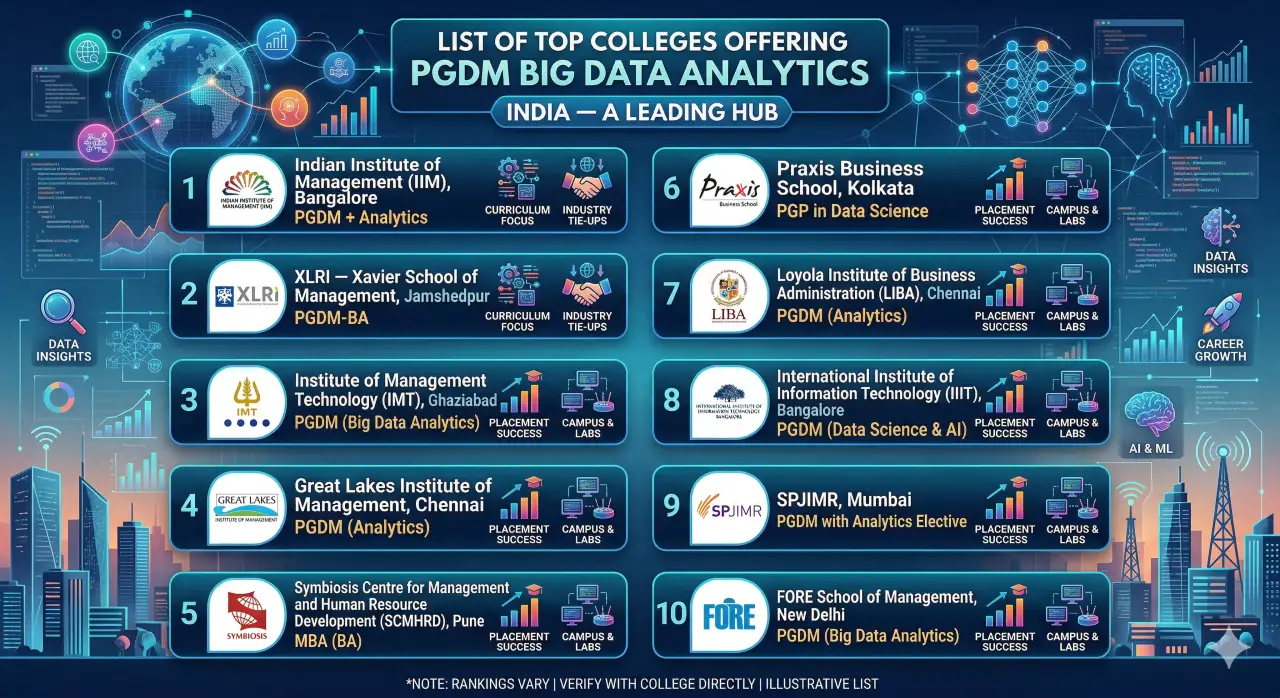
For a real-world example of how this checklist plays out for a specific course, see our breakdown of PGDM colleges in Big Data Analytics, where we walk through exactly this kind of verification.
How to Choose the Right College: A Practical Framework
You don’t need forty tabs open and a spreadsheet with 60 columns. You need a short, disciplined process.
Step-by-Step Checklist Before You Apply
- Shortlist by course fit first, brand name second. Your career depends more on skills learned than on the logo on your degree.
- Pull placement data for your exact stream, not the institution’s overall number.
- Check NIRF rank alongside official NIRF data directly — comparison sites sometimes carry outdated figures.
- Calculate total four-year cost, including hostel, mess, books, and certifications.
- Talk to at least two current students or recent alumni from your target course, not just the ones the college puts forward.
- Ask about internship mandates and industry projects built into the curriculum, not offered as optional add-ons.
- Confirm access to career counselling and whether it starts in year one or only before final placements.
Running through NIRF-ranked options for a specific region helps too — our engineering colleges ranking for Delhi NCR shows how this framework applies when you’re comparing five or six institutions at once.
What to Do If You’re Stuck Between Two Colleges
Compare cost-per-placement-percentage as a rough ratio. A cheaper college with 70% placement often beats an expensive one with 55%.
Weigh location against family support only if finances are tight. Otherwise, prioritize the course and faculty quality over convenience.
If both colleges tie on paper, pick the one with stronger recent industry tie-ups — that’s where AI-era hiring is heading, not toward legacy reputation alone.
Conclusion
Choosing the right college in 2026 comes down to verified data over brand perception — check curriculum relevance, real placement numbers by department, total cost, and career counselling access before you sign any admission form. NIRF ranking helps you shortlist, but it shouldn’t be your only factor, especially with employability gaps still sitting around 43-48% across tiers. Your best decision blends course fit, financial planning, and a clear read on where your industry is actually hiring. Start your shortlist today using the factors to consider while choosing a college listed above, and cross-check every claim before you commit four years and a good chunk of your family’s savings.
FAQs
What are the most important factors to consider while choosing a college?
Curriculum relevance, verified placement data, and total cost of education matter most. NIRF ranking and accreditation help you shortlist, but department-wise outcomes and faculty-industry exposure predict your actual career results better than overall brand reputation.
Is NIRF ranking enough to choose the right college?
No, NIRF ranking alone isn’t enough. It includes perception-based scoring alongside outcome data, so pair it with course-specific placement percentages, median salary figures, and recruiter names before deciding.
How do I check if a college’s placement claims are real?
Ask for department-wise data, not college-wide averages. Request median package figures instead of the highest offer, and confirm whether internships get counted separately from full-time placements.
Does college location matter for career growth in India?
Yes, but less than curriculum and placements. Location affects networking and internship access in metro cities, though a strong course with solid industry connections can outweigh location in most fields today.
How much does educational skill gap affect Indian graduates?
It affects them significantly. Reports show only 8.25% of graduates work in roles matching their academic background, while employability across tiers ranges from roughly 43% to 48%, driven largely by outdated curricula.
Should I prioritize a private or government college for better career deciding factors?
Neither type wins by default. Government colleges often cost less with strong faculty, while private colleges may offer better infrastructure and industry tie-ups — verify placement and curriculum data for your specific course either way.